





Fonte:
idsf.org.il
Autore:
Giovanni Giacalone
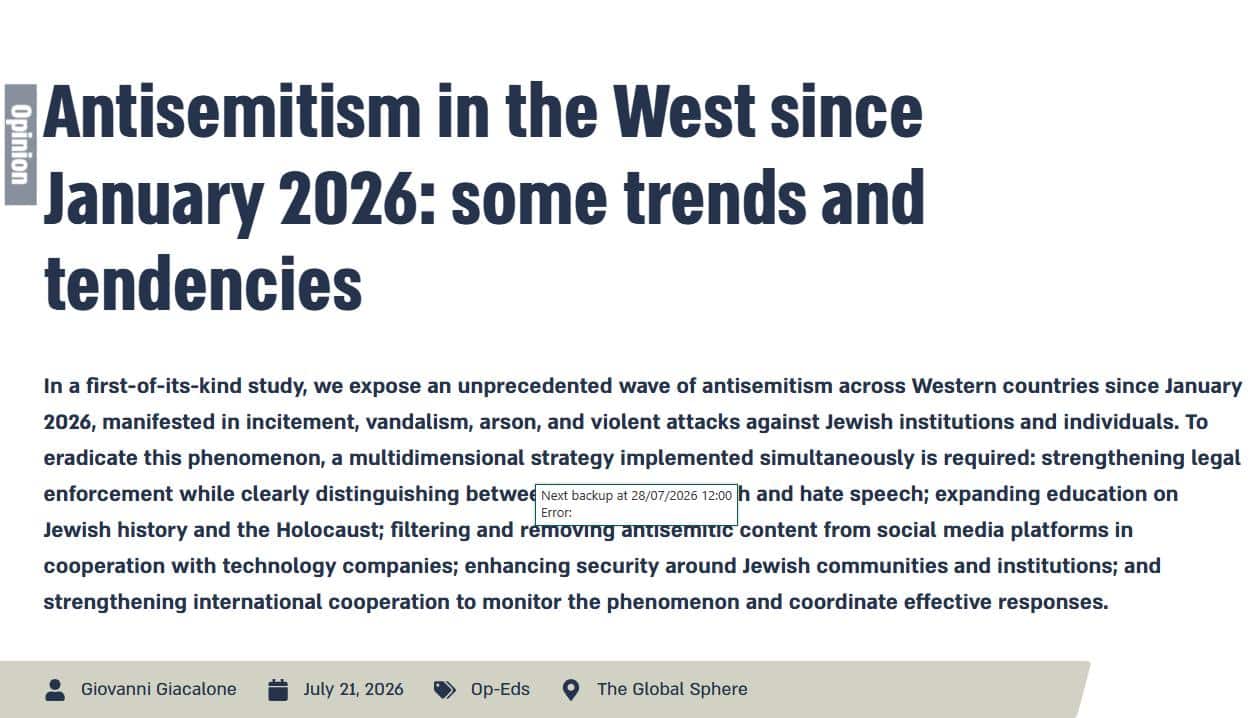
Antisemitism in the West since January 2026: some trends and tendencies
In a first-of-its-kind study, we expose an unprecedented wave of antisemitism across Western countries since January 2026, manifested in incitement, vandalism, arson, and violent attacks against Jewish institutions and individuals. To eradicate this phenomenon, a multidimensional strategy implemented simultaneously is required: strengthening legal enforcement while clearly distinguishing between freedom of speech and hate speech; expanding education on Jewish history and the Holocaust; filtering and removing antisemitic content from social media platforms in cooperation with technology companies; enhancing security around Jewish communities and institutions; and strengthening international cooperation to monitor the phenomenon and coordinate effective responses.
The Hamas attack on Israel on 7 October 2023 and the subsequent war in Gaza triggered one of the most significant increases in antisemitic incidents recorded in Western countries in recent decades. As it will be seen shortly, governments, Jewish organizations, universities, and human-rights monitors across North America, Europe, and Australia reported sharp rises in harassment, vandalism, threats, and physical attacks directed at Jews and Jewish institutions.
Scholars and policymakers have debated the causes of this rise. Some argue that the conflict intensified pre-existing antisemitic attitudes, which were then amplified through social media, political polarization, and public demonstrations. Others emphasize the difficulty of distinguishing between legitimate criticism of Israeli government policies and expressions that cross into antisemitism. Nevertheless, major monitoring organizations consistently reported that a significant proportion of incidents involved explicit anti-Jewish language, threats, Holocaust references, or attacks against Jewish individuals and institutions regardless of their views on Israeli politics.[1] [2] [3]
In the United States, the Anti-Defamation League (ADL) recorded more than 10,000 antisemitic incidents during the year following 7 October 2023, describing it as the highest number ever documented in a single-year period since the organization began tracking such incidents in 1979. According to the ADL, this represented an increase of more than 200 percent compared with the same period a year earlier. The organization reported over 8,000 incidents of harassment, more than 1,800 acts of vandalism, and over 150 physical assaults. College campuses were particularly affected, with antisemitic incidents increasing approximately fivefold compared with the previous year.[4] [5]
The United Kingdom experienced a similar surge. The Community Security Trust (CST), which monitors antisemitism in Britain, recorded 4,103 antisemitic incidents in 2023, the highest annual total in its history. Two-thirds of these incidents occurred after 7 October. CST reported that the 2,699 incidents recorded between October and December 2023 alone exceeded any previous annual total on record. The organization described the period as unprecedented, noting that antisemitic incidents increased by 589 percent compared with the same period in 2022. [6]
The increase was visible across multiple sectors of society. Jewish schools, universities, synagogues, and community centers reported heightened security concerns. In Britain, incidents affecting schools rose by more than 200 percent following the October 7 massacre, while university-related incidents more than tripled. Similar concerns emerged on American campuses, where debates over the Gaza war frequently coincided with accusations of antisemitic rhetoric, intimidation, or exclusion directed at Jewish students. [7]
The phenomenon was not confined to the United States and Britain. Reports from France, Germany, Australia, and other Western countries documented substantial increases in antisemitic acts. Reuters summarized data from multiple national organizations showing record or near-record levels of antisemitic incidents across several democracies following the outbreak of the war.[8]
By 2024 and 2025, incident levels in some countries declined from the extraordinary peaks immediately following October 2023 but remained substantially above historical norms. CST reported that antisemitic incidents in the United Kingdom fell from their 2023 record but still constituted the second-highest annual total ever recorded. In the United States, the ADL reported another record year in 2024, suggesting that elevated levels of antisemitism had become a sustained reality rather than a temporary reaction to a single event. [9]
Overall, the period following 7 October 2023 therefore represents a significant turning point in the contemporary history of antisemitism in the West. While the political causes and interpretations of the trend remain contested, the documented rise in anti-Jewish incidents across multiple democratic societies is one of the most extensively recorded and studied consequences of the conflict. In short, the antisemitic epidemic is once again spreading in the West.
Europe and the United Kingdom since January 2026
Since January 2026, Europe and the UK have experienced a notable number of antisemitic incidents, ranging from hate crimes and vandalism to violent attacks against Jewish individuals, institutions, and community organizations. Governments, law enforcement agencies, and Jewish representative bodies across the continent have expressed concern that geopolitical tensions in the Middle East, particularly the confrontation involving Israel and Iran, have contributed to an increasingly hostile environment for some Jewish communities. Reports from several European countries have documented attacks on synagogues, Jewish-owned businesses, memorial sites, and community facilities.
The United Kingdom
The United Kingdom has been one of the most visible examples of this trend. During the spring of 2026, a series of antisemitic incidents targeted Jewish institutions in and around London. These included arson attacks, attempted attacks on synagogues, and other acts directed at Jewish communal organizations. Members of Parliament from across the political spectrum condemned these incidents, emphasizing that antisemitism has no place in British society.
Particularly significant were the attacks in Golders Green, a North London area with a large Jewish population. On 23 March 2026, four ambulances operated by the Jewish volunteer emergency service Hatzola were destroyed in an arson attack outside a synagogue. The attack caused extensive damage and was widely condemned by political and religious leaders as an antisemitic act targeting a service that assists both Jewish and non-Jewish residents. British authorities launched a major investigation, including consideration of possible international connections. [10]
A second major incident occurred on 29 April 2026, when two Jewish men were stabbed in Golders Green in what British police classified as a terrorist attack. Investigators stated that the victims appeared to have been targeted because they were visibly Jewish. The attack intensified concerns about the security of Jewish communities in the United Kingdom and prompted renewed calls for stronger protective measures. Senior political leaders, including Prime Minister Keir Starmer, publicly condemned the assault. [11]
Also in April 2026, an attempted firebomb attack targeted Finchley Reform Synagogue in north London. According to police, two suspects threw petrol-filled bottles at the synagogue. Although the devices failed to ignite and no injuries occurred, authorities classified the incident as an antisemitic hate crime. [12]
Beyond these specific incidents, concerns about antisemitism have extended into public institutions. In June 2026, a government-commissioned review reported significant problems of antisemitic harassment and discrimination affecting Jewish staff and patients within parts of the National Health Service (NHS), leading to new measures aimed at combating antisemitism and protecting affected individuals. The new measures will ban staff from wearing political badges, including pro-Palestinian symbols, under new rules aimed at fighting antisemitism within the health system. [13] [14] [15]
France
Within the EU, France continued to record one of the highest levels of antisemitic activity in Europe. In January 2026, public controversy erupted after several school textbooks reportedly described victims of the 7 October 2023 Hamas attack as “Jewish settlers,” prompting criticism from President Emmanuel Macron and the withdrawal of the books. [16]
In February 2026, a 13-year-old Jewish boy walking to a synagogue in Paris was reportedly assaulted by a group of youths who beat him, threatened him with a knife, robbed him and made antisemitic remarks. The attack received national attention and renewed calls for stronger action against antisemitism. [17]
French authorities also reported that antisemitic incidents remained at historically high levels, accounting for more than half of all anti-religious incidents recorded in the country. [18]
Germany
In March 2026, police in Munich opened an investigation into vandalism targeting an Israeli-owned restaurant. Attackers damaged the premises using suspected pyrotechnic devices, and investigators stated that antisemitism was considered a likely motive. The incident occurred against a backdrop of heightened concern over antisemitic offenses in Germany since late 2023. [19]
German authorities have also continued to report elevated levels of antisemitism, online and offline, leading to ongoing debates about security for Jewish institutions and the spread of antisemitic narratives online and offline. [20]
The Netherlands and Belgium
The Netherlands experienced several serious incidents in March 2026. On 14 March, an explosion damaged a Jewish school in Amsterdam in what local authorities described as a targeted attack. No injuries were reported, but the incident caused significant concern within the Jewish community. [21]
Shortly afterward, an explosion outside a synagogue in Rotterdam caused a fire and prompted a terrorism investigation. Dutch prosecutors stated that the attack appeared intended to intimidate the Jewish community. Four teenagers were subsequently arrested in connection with the incident. [22]
In Belgium, on 9 March 2026, an explosion struck a synagogue in Liège. The blast caused substantial damage to the building but no injuries. Belgian authorities classified the incident as an antisemitic attack and transferred the investigation to federal prosecutors. Belgium’s Interior Minister publicly condemned the attack as a “despicable antisemitic act.” [23]
Italy
In Italy, concern over antisemitism remained significant in the first half of 2026. Jewish organizations and researchers reported continuing antisemitic incidents and hostility directed at Jewish individuals and institutions. Public discussions highlighted the persistence of antisemitic attitudes and threats, particularly in the context of tensions related to the Middle East. [24]
The CDEC Foundation’s Antisemitism Observatory, which continuously monitors antisemitic incidents in Italy, recorded 183 cases between January and March 2026. Of these, 133 involved online antisemitism, including 6 incidents that occurred both online and offline. The remaining 50 cases involved practical actions, including 2 assaults, 7 offline threats, 9 instances of discrimination, 19 cases of antisemitic graffiti, and 2 acts of vandalism. [25]
The first assault occurred on March 1st in Milan, where two Jewish boys were approached outside a supermarket and surrounded by a group of about ten youths of North African origin who began insulting them with anti-Israel slogans. Despite their attempts to escape, the two were stopped, and one of them was punched in the face. [26]
In Milan, a Jewish woman employed in a professional’s office was repeatedly harassed, insulted with phrases such as “Jewish woman, you are disgusting, Jews must die” and finally physically attacked by her employer, who grabbed her forcefully, pushed her and violently pulled her, causing her injuries that required medical attention. [27]
Most incidents are recorded, as usual, in the regions (Lombardy and Lazio) where the largest Jewish communities are located and where Jewish tourists (especially Israelis) are also present. The regions with the highest number of cases of antisemitism are also those (in addition to Lombardy and Lazio, Piedmont, Tuscany, Veneto, and Emilia-Romagna) where extremist movements are most organized and deeply rooted. [28]
The main victims are no longer just well-known figures of Italian Judaism. The phenomenon affects workplaces, schools, and healthcare facilities, affecting private citizens. Cases of particular gravity are those involving students (even elementary school students), forced to do so because of their Jewish roots. [29]
In the period between April and June 2026, antisemitic incidents are further increasing in Italy, pending the CDEC report on the first six months of the year.
Spain and Portugal
In Spain, January 2, 2026, an online map identifying businesses in Catalonia with Jewish or Israeli links was widely criticized for targeting individuals and companies on the basis of their perceived identity or associations. Later that month, between 25 and 26 January, over 20 Jewish graves were desecrated at the Les Corts cemetery in Barcelona. The city’s authorities temporarily closed the Jewish sections of three city cemeteries while investigating. [30] [31]
In early June, rail cars in Spain that were reportedly destined for Tel Aviv were vandalized. [32]
In Portugal, on May 12, the Jewish Cultural Center on Lisbon’s historic Jewish Street reported antisemitic graffiti that included threats against Israelis and expressions of support for Hamas. The organization characterized the act as intimidation directed at Jews and Israelis rather than political protest. [33]
On 21 May 2026, the Jewish Community of Lisbon reported graffiti reading “Free Palestine from the river to the sea” on the synagogue gate and nearby structures. The community formally described the incident as antisemitic vandalism. [34]
Together, these incidents contributed to concerns expressed by Jewish organizations and human rights groups about the persistence of antisemitic acts in both countries.
The United States and Canada
The first half of 2026 saw continued antisemitic activity across both the United States and Canada, ranging from vandalism and intimidation to attacks on synagogues and other violent incidents. While the scale and characteristics of incidents differed between the two countries, Jewish organizations, law-enforcement agencies, and government officials in both nations expressed concern about the persistence of anti-Jewish hatred and the need for stronger measures to protect Jewish communities and institutions.
In March, a vehicle was driven into a synagogue complex in West Bloomfield, Michigan, in what federal authorities described as a targeted act of violence against the Jewish community. The incident prompted a federal investigation and renewed discussion about the security of Jewish institutions. [35]
Other cases involved vandalism and hate symbols. In January, antisemitic graffiti, including swastikas and references to Adolf Hitler, was repeatedly painted on a playground in Brooklyn’s Borough Park neighborhood, home to a large Orthodox Jewish population. The New York Police Department’s Hate Crime Task Force opened an investigation while State and city officials publicly condemned the acts. [36]
Additional reported incidents included antisemitic graffiti at Jewish institutions in California and a vehicle crash into the entrance of the Chabad-Lubavitch World Headquarters in Brooklyn, which authorities investigated as a possible hate crime. [37] [38]
As to Canada, the country experienced a particularly troubling rise in violent antisemitic incidents during the first months of 2026. According to B’nai Brith Canada, by May 2026 the country had already recorded more violent antisemitic incidents than during all of 2025, leading the organization to warn that 2026 could become the most violent year for Canadian Jews in recent memory. [39]
Toronto and the surrounding area were the site of several serious incidents. In March, three synagogues in the Toronto region were targeted by shootings within a matter of days:
- Multiple gunshots were fired at Shaarei Shomayim synagogue in North York, in the Greater Toronto Area, on March 7, 2026. No injuries were reported. [40]
- The front doors of Beth Avraham Yoseph (BAYT) congregation in the Toronto suburb of Thornhill were sprayed with gunfire on the night of March 7, 2026. Bullet holes and damage were found at the site. No injuries were reported. [41]
- Gunshots were fired at Temple Emanu-El in North York, in the Greater Toronto Area, on March 2, 2026. No injuries were reported. Law enforcement discovered evidence of gunfire and damage to the building as a result of the attack. Although no injuries were reported, the attacks heightened concerns about escalating violence directed at Jewish institutions. [42]
Two months before, in early January, a Winnipeg synagogue was vandalized with swastikas and other antisemitic graffiti, prompting a hate-crime investigation by local police. [43]
In May, Jewish worshippers leaving a synagogue in Toronto were reportedly targeted with a gel-blaster shooting from a passing vehicle. On April 30, a similar episode occurred to Jewish individuals walking in the Bathurst Street and Lawrence Avenue area. These incidents formed part of the broader pattern of attacks against synagogues and Jewish community members documented by advocacy groups. [44] [45]
In June 2026, Canadian Prime Minister Mark Carney announced new federal initiatives aimed at combating antisemitism, citing levels of anti-Jewish hate not seen in Canada since World War II.
On June 16, during a press conference, the chief of the Toronto police, Myron Demkiw, said that young people are being recruited through encrypted messaging apps to carry out the attacks targeting Jewish sites in the city. “In order to get paid, they’re required to film their attacks. Who’s paying for this? This is what we are trying to determine,” Demkiw stated. [46] [47]
Six days later, on June 22, a massive shooting erupted in Montreal’s Côte-des-Neiges neighborhood, an area heavily populated by the Jewish community featuring multiple kosher markets and restaurants. A gunman wearing camouflage ambushed responding officers from a building. The attack left three dead: Montreal police officer Mohamed Lamine Benredouane, a Jewish civilian bystander named Michael Moshe Mizrahi, and the gunman, 25-year-old Seth Hatfield, from Alberta. Reports indicate the shooter left behind a manifesto tied to extremist “incel” ideology containing antisemitic and anti-Zionist rhetoric. [48]
Australia
Australia entered 2026 amid heightened concern about antisemitism following the December 2025 terrorist attack at Bondi Beach that targeted a Hanukkah celebration and killed 15 people. In response, the Australian government established the Royal Commission on Antisemitism and Social Cohesion on 9 January 2026 to investigate antisemitism and its impact on social cohesion.
The first half of 2026 saw a combination of violent incidents, hate crimes, extremist activity, public controversies, and reports of harassment directed at Jewish Australians.
In Melbourne’s suburb of St Kilda East, five Jewish teenagers were allegedly subjected to antisemitic abuse by occupants of a stolen vehicle. According to reports, the perpetrators shouted antisemitic insults, made Nazi salutes, and used Nazi slogans before allegedly driving the vehicle toward the boys, who fled the scene. The incident attracted national attention and was publicly condemned by Prime Minister Anthony Albanese. [49]
On Australia Day, falling on January 26, 2026, concerns were raised following a “March for Australia” rally in Sydney. A speaker at the event was later charged with publicly inciting hatred after allegedly delivering an antisemitic speech. Media reports further indicated the presence of neo-Nazi supporters among attendees and noted the use of antisemitic rhetoric during the gathering. [50]
In March 2026, antisemitic material appeared in Tasmania in the form of stickers designed to resemble political campaign advertisements. The circulation of these stickers prompted condemnation from members of the Tasmanian Parliament, who denounced their discriminatory content. [51]
The same month, police in Melbourne charged a 13-year-old girl in connection with multiple incidents allegedly targeting Jewish residents. Authorities reported that antisemitic remarks were shouted from a vehicle while eggs were thrown at members of the Jewish community, leading to criminal charges being laid. [52]
Antisemitic incidents continued into April when an arson attack in Melbourne reportedly targeted a billboard promoting an event organized by United Hatzalah, a Jewish emergency medical service organization. The attack was widely condemned as an act of antisemitic vandalism. [53]
In May 2026, another incident occurred in Melbourne when a man wearing a shirt displaying a swastika was arrested outside hearings of the Royal Commission on Antisemitism and Social Cohesion. The arrest took place amid heightened public discussion about antisemitism and social cohesion in Australia, reflecting broader concerns regarding the visibility of extremist symbols and ideologies in public spaces. [54]
Some conclusive thoughts
Since January 2026, all the areas examined above have witnessed cases of antisemitic propaganda, harassment and intimidation. However, some countries have been experiencing more violence compared to others.
For instance, the United Kingdom, specifically London, saw two cases of arson and one stabbing while Canada had four cases of gunshots fired against Jewish targets (in Toronto and Montreal) and the authorities seemingly unable to manage the issue of antisemitism. The US, on their side, witnessed two cases of car-ramming.
Belgium and Holland saw three cases of arson while opportunistic physical assaults were recorded in both Italy and France. These are high numbers considering that the timeframe is under six months.
It is clear that antisemitism remains a significant challenge across Europe and the West, manifesting in hate speech, discrimination, online harassment, vandalism of Jewish institutions, and, in some cases, violent attacks. Addressing this phenomenon requires a comprehensive approach that combines legal, educational, technological, and societal measures while safeguarding fundamental rights and freedoms. Indeed, such approaches need to be contextualized to the laws and regulations of each specific country as there is no generical solution to the issue of antisemitism.
It is also essential to strengthen and expand cooperation between countries affected by anti-Semitism and the State of Israel, particularly with the Ministry of Diaspora Affairs, in monitoring the phenomenon and coordinating appropriate responses.
Some general guidelines for an effective strategy to counter anti-Semitism in the West should include:
Strengthening Legal Frameworks
State authorities should continue to strengthen the enforcement of existing anti-discrimination and hate-crime legislation, drawing a clear line between “freedom of speech” and “hateful content”. Law enforcement agencies and judicial authorities should receive specialized training to identify, investigate, and prosecute antisemitic crimes effectively. Improved data collection and cross-border cooperation can also enhance the understanding and prevention of antisemitic incidents.
Education and Historical Awareness
Education remains one of the most effective long-term tools against prejudice. School curricula should include accurate teaching about Jewish history, culture, and the Holocaust, as well as broader education on democratic values, human rights, and critical thinking. Support for visits to memorial sites, museums, and educational programs can help younger generations understand the consequences of hatred and intolerance.
Addressing Online Antisemitism
Digital platforms have become major channels for the spread of antisemitic content and conspiracy theories. Governments, regulators, and technology companies should cooperate to improve the detection and removal of illegal hate speech while respecting freedom of expression. Promoting digital literacy and media literacy can also help citizens identify misinformation and extremist narratives.
Enhancing Security for Jewish Communities
Jewish schools, synagogues, cultural centers, and community organizations may require additional security support where threat assessments indicate elevated risks. Public authorities should maintain close dialogue with Jewish communities to ensure that protective measures are proportionate, effective, and responsive to local circumstances.
The multi-level indications suggested above must be implemented simultaneously in order to have a mechanism that is educational, preventive and coercive, according to the specific situation.
- https://journals.sagepub.com/doi/10.1177/14749041261434618 ↑
- https://isca.indiana.edu/publication-research/social-media-project/current-projects/anti-israel-campus-groups-draft.html ↑
- https://www.isdglobal.org/digital-dispatch/rise-in-antisemitism-on-both-mainstream-and-fringe-social-media-platforms-following-hamas-terrorist-attack/ ↑
- https://go.adl.org/resources/press-release/over-10000-antisemitic-incidents-recorded-us-oct-7-2023-according-adl ↑
- https://www.adl.org/resources/report/audit-antisemitic-incidents-2024 ↑
- https://cst.org.uk/news/blog/2024/02/15/antisemitic-incidents-report-2023 ↑
- https://www.theguardian.com/news/2024/feb/15/antisemitic-incidents-in-uk-schools-soared-in-2023-charity-reports ↑
- https://www.reuters.com/world/americas/antisemitic-anti-israeli-attacks-around-world-since-october-7-2023-2025-10-02/ ↑
- https://cst.org.uk/research/cst-publications/antisemitic-incidents-2024 ↑
- https://www.bbc.com/news/articles/c5yz3j256jlo ↑
- https://www.bbc.com/news/articles/cwy2r39dqp7o ↑
- https://www.theguardian.com/uk-news/2026/apr/15/police-hunt-two-suspects-over-attempted-arson-attack-on-london-synagogue ↑
- https://www.theguardian.com/society/2026/jun/04/nhs-to-tackle-antisemitism-after-report-finds-jewish-staff-and-patients-routinely-ostracised ↑
- https://www.timesofisrael.com/in-antisemitism-crackdown-uk-will-bar-nhs-workers-from-wearing-political-badges/ ↑
- https://www.gov.uk/government/publications/lord-mann-review-on-antisemitism-and-other-forms-of-racism-in-the-nhs/lord-mann-review-of-antisemitism-and-other-forms-of-racism-in-the-nhs-and-healthcare-regulatory-system ↑
- https://www.france24.com/en/live-news/20260114-french-publisher-withdraws-school-books-over-jewish-settler-reference ↑
- https://combatantisemitism.org/cam-news/french-jewish-boy-attacked-at-knifepoint-while-walking-to-synagogue-in-paris/ ↑
- https://www.euronews.com/my-europe/2026/05/29/france-sees-as-sharp-rise-in-anti-jewish-anti-christian-and-anti-muslim-acts-says-governme ↑
- https://combatantisemitism.org/cam-news/explosive-devices-target-israeli-restaurant-in-munich-in-suspected-antisemitic-attack/ ↑
- https://www.timesofisrael.com/antisemitism-in-germany-worse-than-any-time-since-the-holocaust-annual-figures-show/ ↑
- https://www.theguardian.com/world/2026/mar/14/deliberate-attack-explosion-damages-jewish-school-in-amsterdam ↑
- https://nypost.com/2026/03/17/world-news/four-teens-arrested-in-dutch-synagogue-explosion/ ↑
- https://www.reuters.com/world/synagogue-belgian-city-liege-damaged-explosion-vrt-reports-2026-03-09/ ↑
- https://eurojewcong.org/news/ejc-in-the-media/jerusalem-post-italy-the-new-face-of-an-old-hate/ ↑
- https://www.osservatorioantisemitismo.it/notizie/episodi-di-antisemitismo-in-italia/ ↑
- https://www.osservatorioantisemitismo.it/episodi-di-antisemitismo-in-italia/nord-italia-aggressione-fisica/ ↑
- https://www.osservatorioantisemitismo.it/episodi-di-antisemitismo-in-italia/milano-donna-ebrea-vessata-minacciata-ed-aggredita/ ↑
- https://www.osservatorioantisemitismo.it/notizie/episodi-di-antisemitismo-in-italia/ ↑
- Ibid ↑
- https://combatantisemitism.org/cam-news/jewish-cemetery-in-barcelona-desecrated-in-latest-spain-antisemitic-incident/ ↑
- https://www.timesofisrael.com/spanish-jews-fear-that-map-of-local-zionist-businesses-will-lead-to-violence/ ↑
- https://www.jpost.com/diaspora/antisemitism/article-899381 ↑
- https://portuguesejewishnews.com/news/rua-da-judiaria-in-lisbon-vandalized-with-threats-against-israelis/ ↑
- https://portuguesejewishnews.com/news/new-episode-of-antisemitism-now-at-lisbon-synagogue/ ↑
- https://eu.detroitnews.com/story/news/local/oakland-county/2026/03/12/active-shooter-west-bloomfield-synagogue/89119612007/ ↑
- https://nypost.com/2026/01/21/us-news/vile-antisemites-scrawl-swastikas-across-playground-in-heavily-jewish-nyc-neighborhood-over-two-straight-days/ ↑
- https://www.nbclosangeles.com/news/local/pasadena-jewish-temple-vandalism-eaton-fire/3831101/ ↑
- https://edition.cnn.com/2026/01/22/us/new-york-swastikas-playground-investigation ↑
- https://www.bnaibrith.ca/bnai-brith-canada-special-report-antisemitic-violence-in-canada-is-out-of-control/ ↑
- https://thecjn.ca/news/second-suspect-arrested-in-connection-with-toronto-area-synagogue-shootings/ ↑
- https://www.nytimes.com/2026/03/07/world/canada/toronto-synagogue-shootings-canada.html ↑
- https://www.adl.org/resources/article/tipping-point-canadas-jewish-community-faces-unprecedented-threat-three/ ↑
- https://www.cbc.ca/news/canada/manitoba/antisemitism-graffiti-winnipeg-synagogue-swastika-9.7032880 ↑
- https://www.timesofisrael.com/2026-most-violent-year-in-recent-memory-for-canadas-jews-bnai-brith-warns/ ↑
- https://www.tps.ca/media-centre/news-releases/66002/ ↑
- https://www.timesofisrael.com/liveblog_entry/toronto-police-say-hired-gunmen-are-targeting-jewish-sites/ ↑
- https://www.thestar.com/news/ontario/toronto-police-to-provide-update-on-multiple-shootings-including-at-us-consulate/article_319f0b6f-28c4-5bcd-9a51-f2ee64c38c38.html ↑
- https://apnews.com/article/montreal-police-officer-killed-hotel-shooting-1f03c8e854d4758061a46c66cfc21c04 ↑
- https://www.theguardian.com/australia-news/2026/jan/20/antisemitic-hate-incident-nazi-slogans-allegedly-yelled-melbourne-ntwnfb ↑
- https://www.abc.net.au/news/2026-01-28/brandan-koschel-social-media-neo-nazi-group-nsn-photos/106275476 ↑
- https://www.abc.net.au/news/2026-03-17/woodruff-condemns-fake-greens-stickers-with-antisemitic-messages/106463608 ↑
- https://www.abc.net.au/news/2026-03-31/melbourne-13-year-old-girl-crime-rampage/106518660 ↑
- https://www.jns.org/news/world/australian-billboard-advertising-synagogue-event-torched ↑
-
https://www.abc.net.au/news/2026-05-06/swastika-shirt-antisemitism-social-cohesion-royal-commission/106646264 ↑