





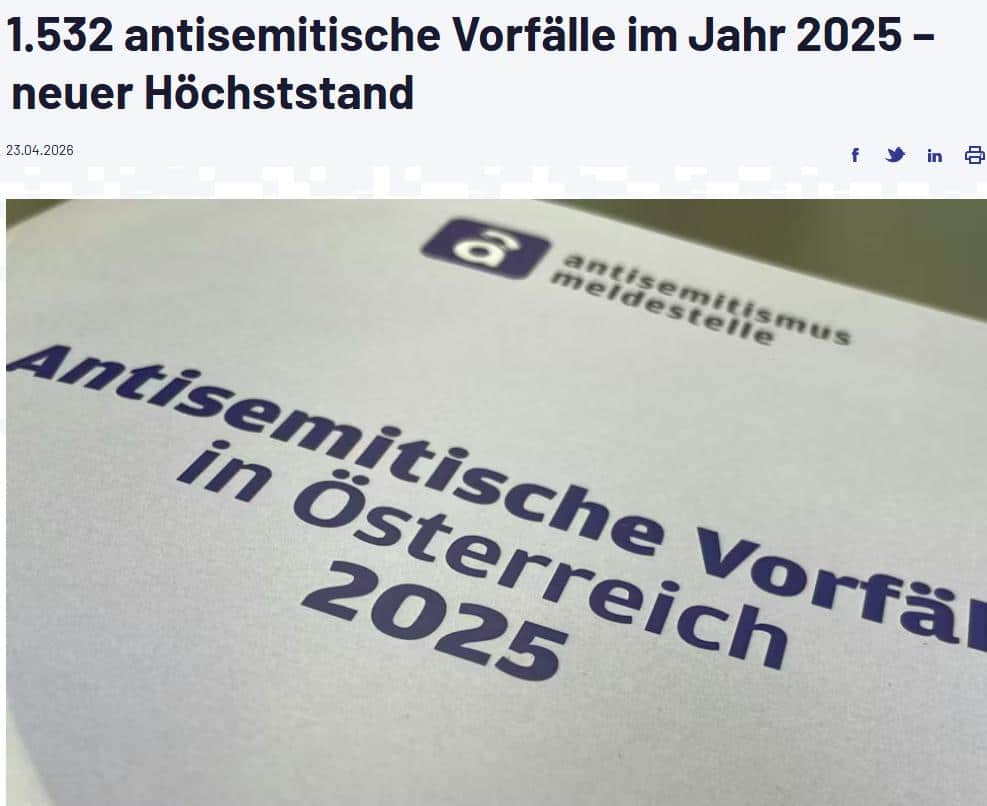
According to the IKG, 1,532 antisemitic incidents were recorded in Austria in 2025
The Antisemitism Reporting Centre of the Israelitische Kultusgemeinde Wien (IKG) has recorded 1,532 antisemitic incidents in Austria in 2025, marking the highest figure since records began. The data confirms a sustained and troubling upward trend that has persisted since 7 October 2023.
The findings were presented on 23 April 2026 by IKG President Oskar Deutsch, Secretary General Benjamin Nägele, and the Head of the Antisemitism Reporting Centre, Johannan Edelman.
The annual total of 1,532 incidents comprises 19 physical attacks, 27 threats, 205 cases of property damage, 439 mass mailings, and 842 instances of offensive behaviour.
On average, 4.2 incidents were recorded per day in 2025—slightly higher than the 4.13 daily average in 2024. While this represents a decrease from the immediate aftermath of 7 October 2023 (8.13 daily incidents between October and December 2023), it remains significantly higher than the period before the escalation, when between January and early October 2023 the average stood at 1.55 incidents per day.
The report highlights a strong shift in the nature of antisemitic incidents. The most prevalent form was Israel-related antisemitism, accounting for 1,186 cases (77.4%), compared to just 21% in 2020.
Other forms also saw marked increases:
- Holocaust relativisation and denial: 625 cases (40.8%), up from 28.7% in 2024
- Antisemitic “Othering”: 750 cases (49%), up from 32% in 2024
Many incidents overlapped across categories. For example, 508 cases of Israel-related antisemitism also involved “Othering”, while 499 included Holocaust distortion or denial.
According to the report, these patterns reflect a growing normalisation of discourse that trivialises the Holocaust or equates Israel with Nazi Germany, while portraying Palestinians as “the new Jews”. The IKG warned that such narratives contribute directly to an increasingly hostile environment for Jewish communities in Austria.
IKG Secretary General Benjamin Nägele described the post–7 October environment as one in which “unrestrained antisemitism has become a constant companion in the daily lives of many Jews”.
IKG President Oskar Deutsch stressed the practical consequences: “Jewish life is only possible thanks to extensive security measures. The Community spends more than five million euros annually on security—resources that are urgently needed elsewhere, such as education, youth work and cultural life.”
The report also points to what it describes as a growing “atmospheric antisemitism”, characterised by gradual desensitisation in society and a decline in reporting willingness. Johannan Edelman warned that this leads to a situation in which Jewish identity is increasingly hidden and Jewish presence in public life is quietly pushed back.
The full 2025 report is available via the Antisemitism Reporting Centre of the IKG.