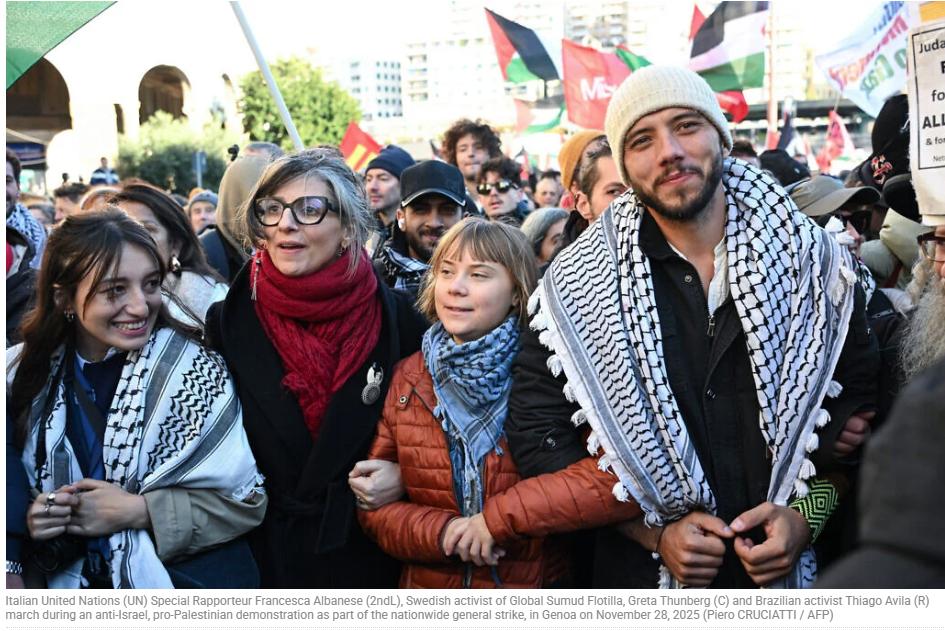
On September 22, 2025, a general protest and strike against Israel’s war in Gaza was organized by a group of smaller and far-left unions. It caught many in Italy by surprise: In Rome, police forces expected a few thousand to join the rally, but by the end of the day, authorities estimated that some 50,000 had taken to the streets. The organizers boasted that 300,000 participants had marched in the capital, in addition to hundreds of thousands more in some 80 cities across the country.
The same day, dockworkers in Genoa blocked access to the city’s major port, demanding that Italy not allow shipments to Israel, and several Italian celebrities either joined the protest or expressed solidarity with it. On live TV, celebrity host Antonella Clerici asked viewers not to remain indifferent to “the massacre” in Gaza during a beloved morning cooking show on Rai1, the most-watched Italian channel.
The following week, Italy’s largest union, the (self-reported) 5-million-strong Confederazione Generale Italiana del Lavoro (CGIL), which had not supported the September 22 initiative, announced its own general strike and protest for Gaza. This took place on October 3, with support from Italy’s two main opposition parties, the center-left Partito Democratico (PD) and the populist Five Star Movement, as well as a smaller coalition of far-left parties, AVS-Verdi.
“Today’s rally is a huge demonstration for Gaza that shows how Italy is better than those who govern it,” said PD general secretary Elly Schlein.
At the same time, according to a survey published in September by prominent pollster SWG, around 15% of Italians consider physical attacks on Jewish people “entirely or fairly justifiable.”
As in many other countries in the world, the war touched off by the bloody October 7, 2023, Hamas invasion of Israel and the widespread devastation documented in the Gaza Strip have spurred outrage among vast sectors of the Italian public. In the past several months, Italian opposition forces have also begun to use Gaza as a rallying cry against the government, sensing the mood in the street while taking heed of surveys suggesting that the issue’s appeal goes beyond the center and left voters.
With the Middle East rapidly becoming a dominant topic across Italian talk shows, social media, and news outlets, many public figures — including political leaders, journalists, and intellectuals — have taken to describing Israel’s actions as genocide. Israel has always maintained that it takes significant measures to minimize civilian casualties, but the Italian citizenry is increasingly unconvinced.
A poll released on September 26 by the Ixè research institute asked 1,000 respondents (with a 3.1 percent margin of error) whether they agreed with “those who accuse Israel of committing genocide against the Palestinians.” Almost 74% responded that they agreed, while 22.6% disagreed and 3.8% did not know. Those who agreed included 89% who had voted for PD and the Five Star Movement in the 2024 European elections, but also 64% of those who voted for Prime Minister Giorgia Meloni’s far-right Fratelli D’Italia (FDI) and 65% of right-wing populist Lega voters (the second-largest party in the governing coalition).
In addition, 59% of the respondents said they were in favor of Italy cutting ties with Israel. Once again, they included not only over 70% of PD and Five Star voters, but also 40% of FDI supporters and 63% of Lega ones.
Illustrating the intensity of conviction among the protesters, Chiara, 17, told the local news outlet Vicenza Today at a protest in Vicenza, a mid-size town in northern Italy, on October 3, that the original sin was born in the United Nations.
“The UN’s 1947 decision to create two states for two peoples was a mistake or bad faith because in this historical process the winning faction was that of revisionist Zionism: authoritarian and fascist,” she said. Chiara explained that she supports the Lega party, “but in this case I chose to be here with my classmates. We have different views on many things, but not on defenseless people inhumanely exterminated.”
When anti-Israel stances backfire
The hope to unite a fragmented opposition, create a political headache for a government that has tried to maintain a more balanced, low-profile stance on Israel — and possibly also poach some of its voters — has represented a powerful temptation, especially for the more moderate PD.
Yet, it has also sometimes backfired.
“This is a vote for Marche and for Palestine,” Matteo Ricci, the center-left coalition candidate for governor of the Marche region in central Italy, said in September on the eve of the elections. Ricci was roundly defeated by the center-right candidate Francesco Acquaroli, and several pundits questioned his fixation on Gaza as opposed to more local issues.
Such criticism has also been directed at the unions and the opposition parties at the national level, especially considering that Italy is suffering from decades of economic stagnation, unemployment, and unbearable fiscal pressure.
In addition, pro-Palestinian rallies have often been marred by violence. Vandalism and the illegal disruption of public transportation leave many Italians confounded — including those sympathetic to the Palestinian cause.
Last Friday, during another general strike promoted by the far-left unions against both the government’s budget law and the war in Gaza, dozens of activists broke into the newsroom of the Italian daily La Stampa in Turin, sprayed graffiti reading “Free Palestine” and “Newspapers are complicit with Israel,” and caused significant damage.
The incident drew considerable censure. It also shocked some Italians who themselves had internalized the fiercest critiques against Israel.
Journalist Annalisa Cuzzocrea, who until a few months ago served as La Stampa deputy editor-in-chief, commented on X that in the past, “[La Stampa editor-in-chief] Andrea Malaguti and I put the word ‘genocide’ in the headline on the front page without worrying about how some segments of the public would react.”
“This is what hurts me the most, because [the activists] don’t know what they’ve attacked,” she added.
The vandalism against La Stampa has also ignited a political storm against another figure who, in Italy, has increasingly been seen as one of the country’s main champions of the Palestinian cause, UN special rapporteur for the Palestinians Francesca Albanese.
Accused of bias against Israel that bordered on antisemitism even before October 7, Albanese has since become a highly influential voice in Italy — as testified by her nearly daily presence on Italian TV, the ubiquity of her book in windows of Italian bookstores, and the numerous prizes and honorary citizenships she received across the country, including in Bologna, Bari and Reggio Emilia (where she scolded the mayor on stage after he expressed hope that the Israeli hostages held by Gazan terror groups would soon come home).
Asked about the attack on the newsroom, Albanese said that she “condemned the violence” but also “condemned the journalists,” who she accused of not providing fair coverage to the Palestinian plight, and called the episode “a warning for the press.” The statements drew condemnation from Meloni and had city leaders second-guessing their decisions to award honorary citizenship to Albanese — including the mayor of Florence, who retracted her city’s offer following the controversy.
Hostile atmosphere for Jews
But those who are paying the highest price of an increasingly hostile atmosphere against Israel are Italy’s Jews.
With some 23,000 official members across the country, over half of whom are in Rome, Italian Jewish communities are small but deeply-rooted, with a presence on the peninsula dating back over 2,000 years.
The most recent report by the Centro di Documentazione Ebraica Contemporanea (CDEC), a Milan-based think tank that monitors antisemitism in Italy, revealed that in 2024, its antisemitism watchdog received 877 complaints about antisemitic incidents in the country, compared to 454 in 2023 and 241 in 2022.
On Monday, the Jewish community of Rome woke up to the distressing news that overnight, the external walls of the Bet Michael synagogue in the hilly Monteverde neighborhood of the city had been defaced by graffiti.
Alongside writings such as “Free Palestine” and “Monteverde is anti-Zionist and anti-fascist,” the vandals covered in black paint the plaque dedicating the synagogue to the memory of Michael Stefano Gay Tache, a 2-year-old boy who was killed in a Palestinian terror attack against the city’s main synagogue in 1982.
The vandalism sparked widespread condemnation, and Italian President Sergio Mattarella called Victor Fadlun, president of the Jewish Community of Rome, to express his solidarity.
Still, many Jews cannot help but feel that the attack represents yet another instance where anti-Israel sentiment has spilled into open antisemitism, rubbing salt into one of the deepest wounds the community still carries.
The 1982 attack also happened amid a climate of public anti-Jewish sentiment fueled by tensions in the Middle East — at the time, the First Lebanon War. In the months before the attack, during a CGIL rally, some protesters had left a white coffin on the synagogue’s doorsteps, and Palestinian leader Yasser Arafat, who at the time had not yet renounced terrorism, had gone to Rome on an official visit.
Fadlun warned in La Stampa against using the rallies for Gaza to attack the government.
“In Gaza, the ceasefire is holding despite the ongoing difficulties, but in Italy, almost exclusively in Italy, pro-Palestinian demonstrations have multiplied, becoming increasingly aggressive,” he said.
“Antisemitism is an abomination that has permeated history, exploiting the lowest sentiments, and it is used as a club to gain power; it’s happening here, now,” he added. “Certain protests aim to put pressure on the government, that’s clear.”
Fadlun also expressed concern about the intersection of union struggles and Middle East politics.
“We Jews of Rome remember well that a union march in 1982 brought a coffin in front of the synagogue,” he said. “Then there was the attack that killed Stefano.”
Photo Credits: www.timesofisrael.com